Temperature Gauge Stuck Low With Engine Hot Warning: Diagnosis & Fixes
Why Your Temperature Gauge Stopped Working (and Why “Engine Hot” Still Shows)
Your temperature gauge is completely dead—stuck on cold—but the dashboard keeps yelling “Engine Hot, AC Off.” That contradiction is actually a clue. These aren’t two random failures; they’re two symptoms pointing to one root cause, and a code scanner can confirm which one.
How Temperature Monitoring Works in Modern Cars
Your vehicle has at least two temperature sensors: one feeds the PCM (powertrain control module, the engine computer), and another feeds the instrument cluster’s gauge. They’re usually the same sensor, but they’re read differently. When the PCM sees a temperature signal, it uses that data to control fuel mixture, ignition timing, and emissions. When it thinks the engine is dangerously hot, it shuts off the AC compressor to free up cooling capacity.
The signal from the temperature sensor travels as voltage. At cold startup (around 40°F), it sends about 4.5 volts. At operating temperature (around 200°F), it drops to roughly 0.5 volts. The PCM interprets that voltage change as temperature.
Why a Dead Gauge + Hot Warning Point to a Sensor Problem
If you replaced the sensor and the gauge is still dead, something is preventing the new sensor’s signal from reaching the gauge circuit. At the same time, the PCM’s temperature reading might be stuck in safe-failsafe mode—it assumes worst-case and goes hot.
Here are the most common culprits:
- Aftermarket sensor quality. Budget sensors from some retailers have poor internal connections or inconsistent calibration. An OEM (original equipment manufacturer) sensor often fixes it immediately.
- Corroded or damaged wiring. You checked the harness at the sensor, but the wire may be damaged downstream—where it passes through the firewall, along the engine block, or inside the wiring loom. Corrosion also builds up at connectors and can block the signal.
- Bad connector or terminal.” Even a tight connector can hide a cracked or separated pin inside. Corrosion on the terminal surfaces is invisible but kills the signal.
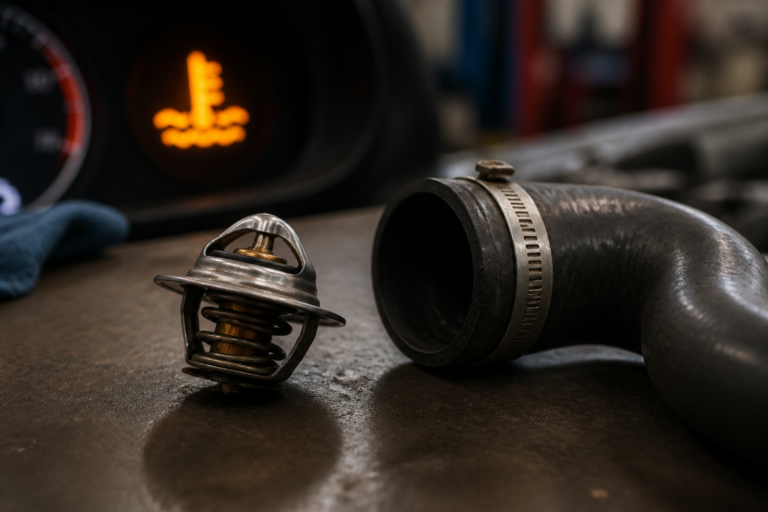
- Thermostat stuck open. If the engine never reaches normal operating temperature, the sensor never gets hot enough to send the right signal, and the gauge reads low or won’t move at all.
- Low coolant level. The sensor has to be in contact with coolant to read temperature. A leak or overfill will prevent accurate readings.
How to Diagnose It: The Code Scanner Approach
A code scanner does two essential things that guessing can’t:
1. Read stored or pending trouble codes. Common codes include P0117 (temperature circuit low), P0118 (temperature circuit high), P0115 (circuit malfunction), or P0128 (thermostat range problem). The code alone narrows the problem significantly. P0117 points to a grounded or shorted signal wire. P0118 suggests an open circuit or pulled-out connector.
2. Monitor live coolant temperature data. Fire up the engine and watch the live temperature reading on the scanner. Does it rise as the engine warms up? Does it climb toward 200°F (90°C) and then hold steady? If it shoots to 250°F or stays frozen at 40°F, you’ve found your problem. If the scanner reading seems reasonable but your gauge doesn’t move, you’ve got a gauge circuit issue instead.
Most auto parts stores (and many independent mechanics) will scan for free or for a small fee.
Common Fixes
If the code points to the sensor: Replace the sensor with an OEM part if possible. Aftermarket sensors can work fine, but some brands (especially very cheap ones) are out of spec from the factory.
If the code points to wiring: Inspect the entire wire harness from the sensor to the PCM. Look for pinched, melted, or corroded sections. Check that the connector is fully seated and the terminals aren’t bent or corroded. If you find corrosion, clean it with electrical contact cleaner and dielectric grease.
If the scanner temp looks fine but the gauge is dead: The problem is in the gauge circuit itself, not the sensor. This usually requires bench testing the gauge cluster or having a tech trace the wiring.
If the thermostat is stuck open: The engine will be slow to warm up and never reach normal temperature. Replace the thermostat and make sure it’s the right specification for your vehicle. (Cheap or wrong-spec thermostats cause persistent temperature issues.)
When to Call a Mechanic
If the code scanner shows the sensor signal is good but the gauge still doesn’t move, or if you’ve replaced the sensor and wiring but the problem persists, have a pro run a full electrical test of the gauge circuit. That’s beyond DIY scope and requires an oscilloscope or advanced multimeter work.
If you keep getting the “Engine Hot” message even after replacing the sensor and checking wiring, the PCM itself may need a software update or the vehicle may have an internal sensor configuration issue that requires dealer diagnostics.
Sources
- carparts.com
- innova.com
- autozone.com
- underhoodservice.com
- ancel.com
- kbb.com
- carparts.com
- autozone.com
Related Articles