
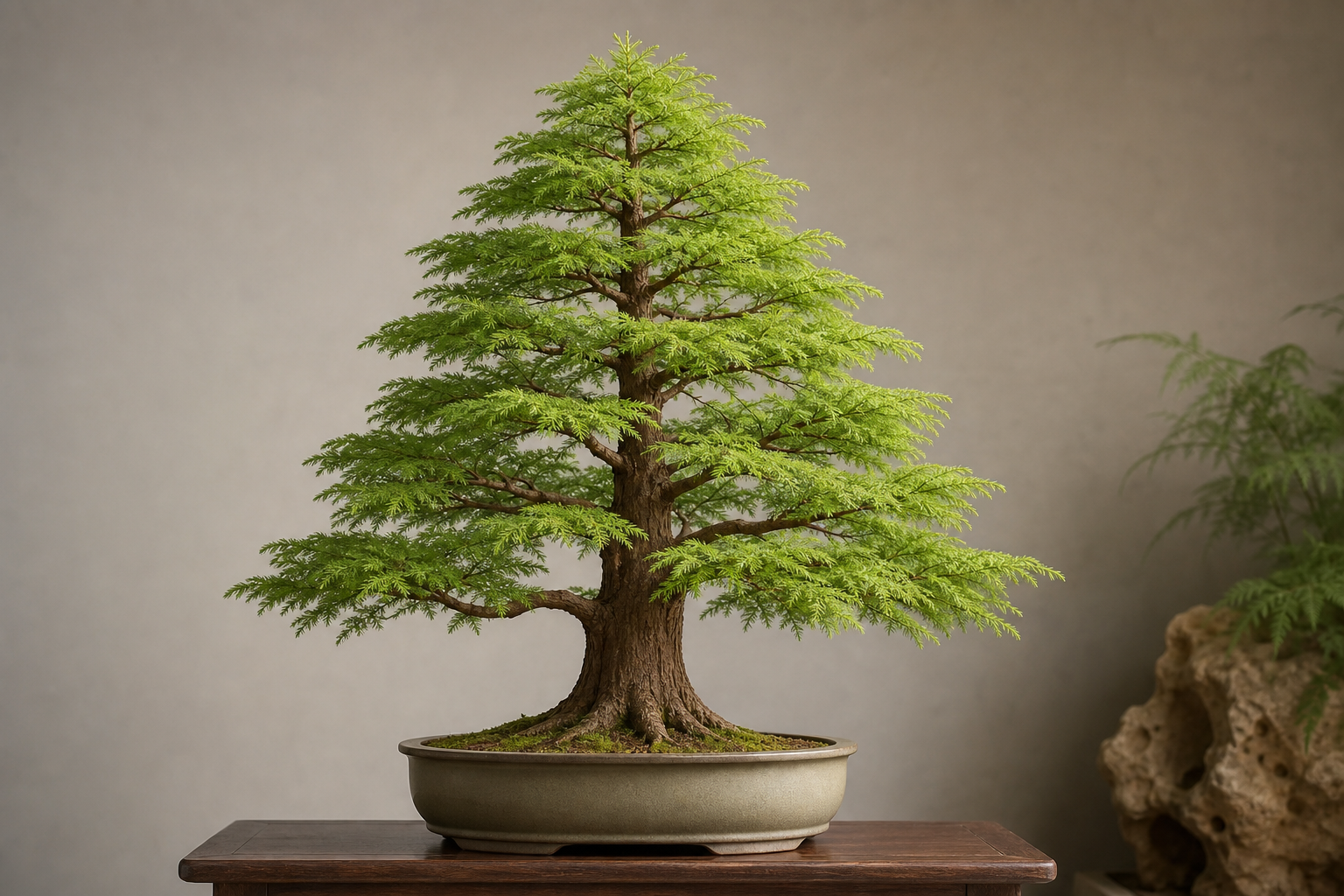
Building a Full Apex on Formal Upright Dawn Redwood Bonsai
Building a Full Apex on Formal Upright Dawn Redwood Bonsai
The formal upright style demands a convincing apex—the apex should taper smoothly and support fine, dense branching rather than broadcasting deadwood. If you’re building your dawn redwood without a tenjin (deadwood apex), you’re committing to a longer, more natural path, but the payoff is a tree that reads as a cohesive, living form rather than a striking but hollow feature.
Understanding Formal Upright Structure
The formal upright style requires a straight trunk with horizontal branching arranged in a tapered, roughly conical silhouette. The lowest branches are thickest and longest, and each successive tier gets progressively shorter and finer toward the apex. This shape serves a practical purpose: it allows light to reach all foliage layers, ensuring the tree develops density at every level.
Your dawn redwood’s fast growth rate is an advantage here. The species develops natural taper easily because each branch thickens the trunk below it through photosynthetic energy. By working multiple leader cuts over several years, you can achieve believable taper without forcing it.
The Multiple-Cut Apex Strategy
Rather than cutting once and hoping, plan for a series of leader cuts over three to five years. Each time you remove the top, select the next leader carefully. Choose a branch that is:
- Positioned off-center or slightly back to avoid a dull vertical line
- Already thinner than the branch below it (natural taper)
- Vigorous enough to dominate but not so massive that it looks disproportionate
Allowing each new leader to grow out fully for a full growing season before cutting it back again builds energy in the tree and gives you perspective on how each section will develop. This patience is what separates a constructed apex from a convincing one.
Clip and Grow for Fine Branching
The clip-and-grow method is the standard technique for developing apex structure. Let new growth extend, then cut it back just before two healthy buds. The key is understanding that you’re trading immediate shape for longer-term branching complexity.
When you allow a shoot to grow out before cutting, the tree creates more internodes (the segments between buds). Each additional internode gives you more branching opportunities in future years. The fine twists and turns that emerge over time look far more natural than a structure you’ve wired into place immediately.
For dawn redwoods, this method works especially well because the species is deciduous and recovers quickly from pruning. You can make a cut in spring and see multiple new leaders emerge by midsummer.
Bud Selection and Apex Density
To build a truly full apex, be intentional about which buds you preserve and which you remove. Near the apex, you want buds that face outward and slightly upward, creating a radiating structure rather than a sparse stick with a few twigs.
Pinch or remove buds that grow straight up or inward. This selective pruning at the earliest stage—before shoots elongate—directs energy to buds that will create the tapered, bushy form you’re after. It’s more effective than waiting until growth is long and then trying to wire branches into position.
Overcoming the Tenjin Temptation
The tenjin (deadwood apex) technique is popular for conifers because it instantly reads as mature and dramatic. But a full, living apex has advantages: it continues to develop fine structure year after year, it’s more forgiving of seasonal variation, and it doesn’t require maintenance of the deadwood itself (scaling, bleaching, stabilizing).
The trade-off is time. A full apex usually takes 5–10 years to truly convince, whereas a jin can look striking in two or three. If you’re willing to invest the years, your tree will reward you with layers of complexity that a static deadwood feature cannot achieve.
Light and Foliage Distribution
Maintain the tapered silhouette as you grow. The lower branches should extend far enough to catch light, but prune them back hard enough that they don’t shade the upper levels. A common mistake is letting the tree grow bulky in the middle while the apex starves.
Every spring, step back and ask: does light reach the foliage all the way up? If not, thin the lower and middle branches more aggressively. Your apex will fill in and foliage will consolidate at the top naturally if the lower layers aren’t hoarding all the photosynthetic capacity.
The Role of Fertilization
During the apex-building years, a balanced or slightly nitrogen-heavy fertilizer supports dense foliage development. Dawn redwoods are vigorous feeders during their growing season (spring through early fall), and generous nutrition accelerates development without forcing unnatural shapes.
However, avoid over-fertilizing late in the season, which can encourage soft, frost-tender growth heading into dormancy. Taper fertilization by midsummer and switch to a lower-nitrogen formula if feeding at all.
Patience as a Technique
Building a full, convincing apex without deadwood is not the fastest route, but it’s one of the most rewarding. Each year of clip-and-grow work deposits more fine structure into the tree. The apex that emerges is uniquely yours, shaped by years of small decisions about which buds to keep, where to direct energy, and how much to let grow between cuts.
Your instinct to avoid the easy tenjin is sound. The challenge of a fully foliaged apex is exactly what makes it worth pursuing.