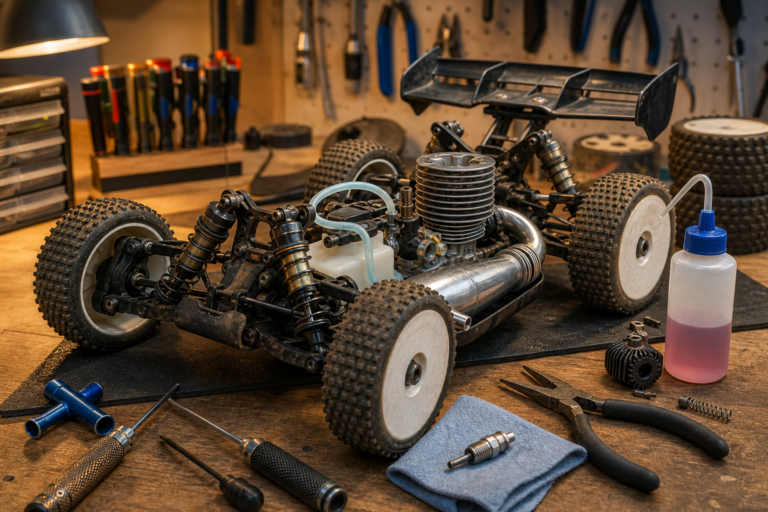
Why Vitavon Arm Droop Screw Hole Angles Matter for RC Suspension
The Vitavon Droop Screw Design Issue: Why Angle Matters
If you’ve recently installed Vitavon aluminum suspension arms on your RC car, you may have encountered a frustrating problem. The droop screw holes are machined at an inward angle toward the chassis rather than perpendicular to the arm surface or angled outward. This design choice creates a significant accessibility problem for anyone trying to adjust their suspension after installation.
What Are Droop Screws and Why They Matter
Droop screws are small fasteners that mount on your RC car’s chassis and contact the suspension arms. They serve a critical function: limiting how far your suspension can extend when the car is unloaded or airborne. Without proper droop adjustment, your suspension compresses too much at rest, reducing available shock travel and potentially causing the shocks themselves to become your suspension’s limiting factor during big air.
Proper droop setup is essential for suspension geometry and performance. Most RC cars use a 2mm hex driver for adjustment, making it possible to fine-tune your setup with basic tools.
The Problem with Inward-Angled Holes
Vitavon arms use larger M5 droop screws compared to the industry standard M4 size. While the larger fastener offers greater clamping force and durability, the hole angle creates a mechanical problem.
When the droop screw hole is angled inward toward the chassis, your hex driver cannot fit between the chassis and the arm head to turn the screw. The arm body physically blocks access. An outward angle would allow clearance for the hex key to engage the screw head easily. The current design requires you to either compress the shocks or partially disassemble components just to make minor suspension adjustments.
Why This Matters in Practice
Droop adjustment is not a set-and-forget task. During track testing, you might need to fine-tune your setup multiple times in a single day. Every adjustment becomes a time-consuming process that shouldn’t be necessary. For casual bashers, this is merely inconvenient. For competitive racers doing suspension tuning, the design creates genuine workflow friction.
The cost of Vitavon arms is premium, reflecting their use of high-quality 7075 aluminum and precise CNC machining. Users expect that investment to translate into practical usability, not engineering compromises that create obstacles during normal maintenance.
Possible Reasons for the Design Choice
Several explanations exist for why Vitavon chose an inward angle. It’s possible that the angle was intended to optimize arm geometry or center-of-mass placement. Angling holes inward could theoretically provide structural advantages in a narrow suspension arm. However, if optimization was the goal, the design should have included droop screws with hollow shafts and hex inserts on the underside, allowing top-down adjustment without accessing the chassis side.
Alternatively, this could be an oversight in the design phase that was discovered too late in the production run to correct without significant retooling costs.
Working Around the Design Issue
If you own Vitavon arms with inward-angled holes, several workarounds exist.
The most straightforward approach is to remove the arms before making droop adjustments, as the original poster discovered. With the arm off the car, you have full access to the screw head and can use your hex driver normally. This takes extra time but ensures you can always make adjustments.
A second option is to upgrade to specialty droop screws with hex inserts in the shaft ends. Some manufacturers produce droop screws designed specifically for tight spaces, featuring a button head and a matching hex opening on the opposite end. You insert the screw from below and can then adjust using the top end without accessing the chassis gap.
You could also partially compress your shocks, which sometimes creates just enough clearance to slip a hex key in at an angle. This works inconsistently depending on your specific car model and setup.
The Bigger Picture
This situation highlights a common tension in RC car aftermarket parts. Premium manufacturers like Vitavon deliver superior material quality and precision machining. Their arms are undeniably well-made from an engineering standpoint. However, superior materials don’t automatically translate to superior design. A high-quality part can still have design compromises that create practical inconveniences.
When considering premium aftermarket arms, it’s worth researching not just material and construction quality, but also functional design choices like droop screw access. Community forums often surface these practical usability issues before you invest.
Sources
- adrenalinercracing.com
- radiocontrolinfo.com
- vitavon-racing.com
- rccarhobbyist.com
- rsrc.biz
- teknorc.com
- vitavon-racing.com
- vrcmag.com